
Latest audit record
Conclusion: Goniobranchus geometricus
Reviewed by Codex identification research on Aug 29, 2026 · 91% reviewer confidence.
Reasoning recorded at review
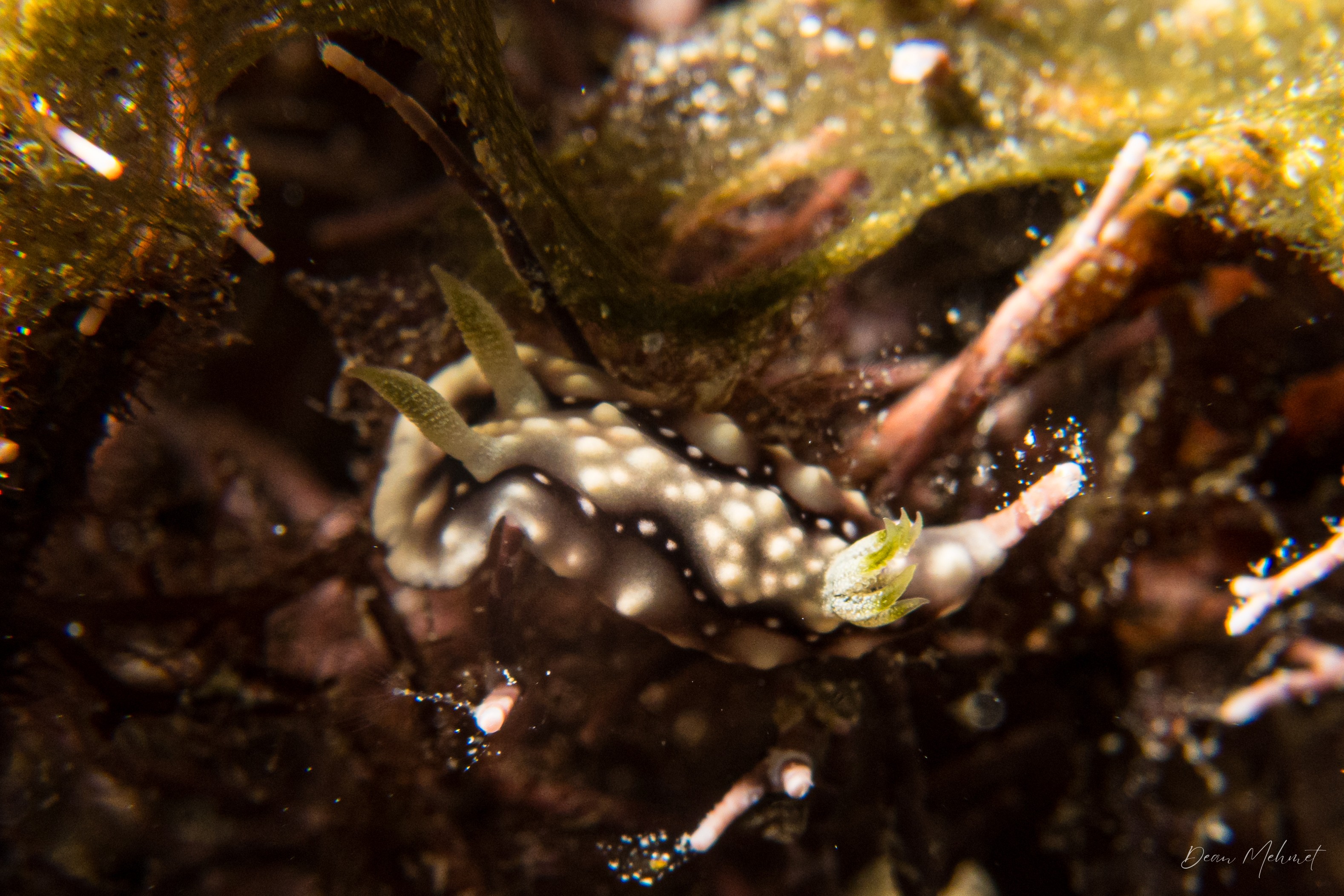
- The dorsum carries multiple rounded creamy-white to yellowish raised pustules rather than flat spots alone.
- Dark brown to purple pigment forms connected reticulations between the pale pustules; the relative dark and pale coverage is variable.
- The rhinophores and seven-to-eight-gill circlet are translucent and white-speckled basally with green to greenish-yellow distal pigment.
- Where exposed, the lifted anterior mantle shows the supporting purple ventral crescent described for western-Pacific G. geometricus.
- Although partly obscured and softly focused, the frame exposes the pustular-reticulate dorsum, both greenish rhinophores, the greenish gill tips, and the lifted anterior mantle.
Alternatives considered
- Goniobranchus conchyliatus
Why plausible: The Indian Ocean counterpart shares a pale pustular body with darker pigment following the pustule contours.
Comparison: G. conchyliatus should have red to reddish-orange rhinophores and gills; the visible appendages here are greenish-yellow, but specimen anatomy or molecular evidence would be required for formal confirmation.
- Goniobranchus hintuanensis
Why plausible: Another white-pustular western-Pacific chromodorid with a grey-brown network.
Comparison: G. hintuanensis should show reddish-brown pigment on rhinophore lamellae/midlines and gill edges plus paired diffuse dark fields, rather than the greenish distal appendage pattern visible here.
- Other white-pustular Goniobranchus / Glossodoris
Why plausible: Yonow explicitly notes multiple pale pustular chromodorids that can be confused from incomplete photographs.
Comparison: A conflicting appendage pattern, flat rather than raised pale markings, or absence of the inter-pustular network would require a broader specimen-backed comparison.
Evidence limits & sources +−
- • No voucher anatomy or molecular sequence is available, so the conclusion remains probable rather than confirmed.
- • Underwater white balance may shift green-yellow appendage pigment; body structure and pattern organization must remain part of the decision.
- • The complete ventral surface, radula, and reproductive anatomy are not available from these photographs.


