
Latest audit record
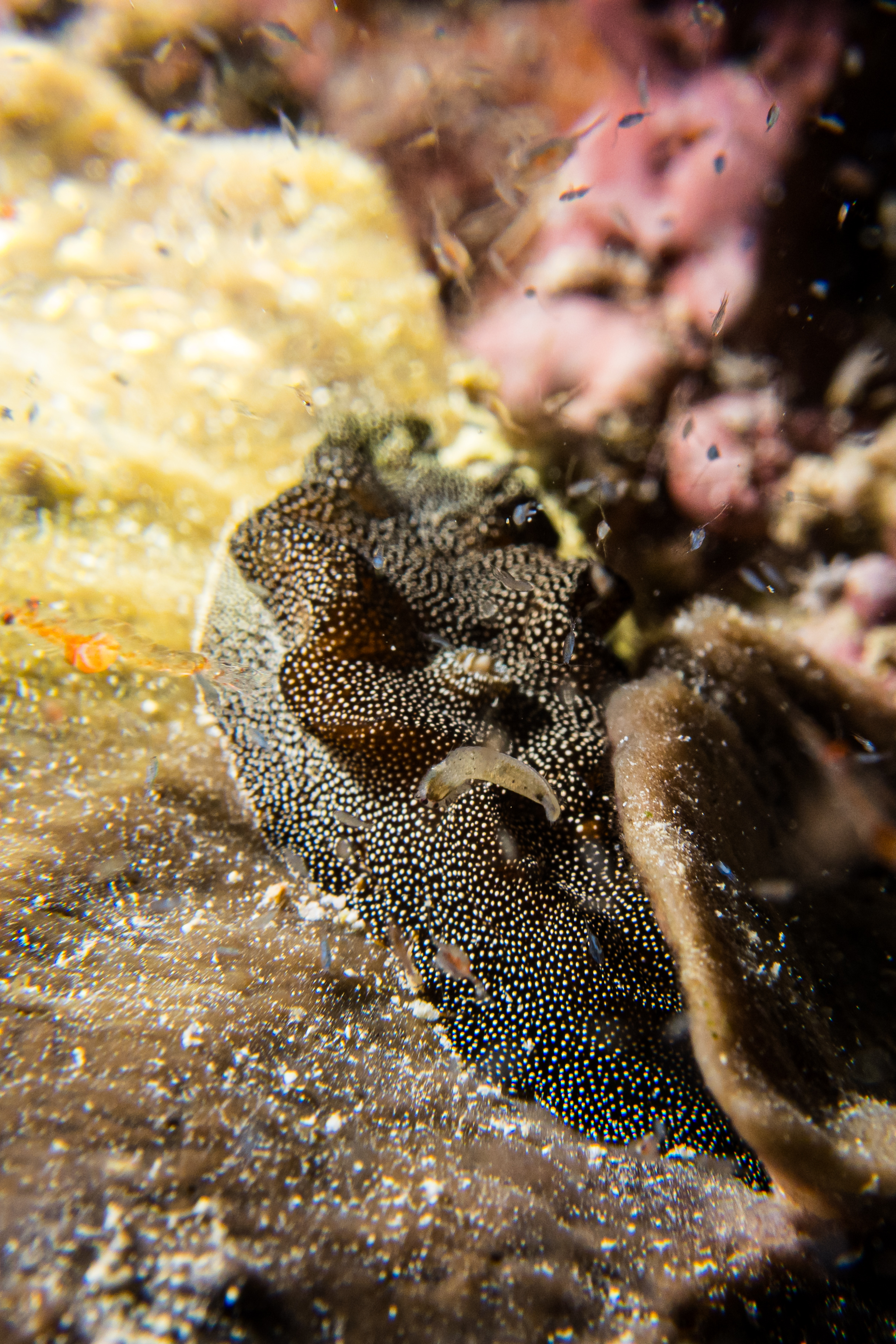
Conclusion: Doriprismatica stellata
Reviewed by Codex identification research on Aug 27, 2026 · 91% reviewer confidence.
Reasoning recorded at review
- Dark brown-black animal densely covered by small closely spaced white specks
- The visible body remains high and firm-looking with a reduced mantle rather than a soft broad dendrodorid skirt
- Dark appendage tissue carries dense pale speckling consistent with the stronger cluster frames
- The partially obscured view does not reveal a red mantle border or the large dark white-tipped gills expected in black-form Dendrodoris fumata
Alternatives considered
- Dendrodoris nigra
Why plausible: An adult can be black or dark grey with white mantle spots, making it a superficial colour-pattern alternative.
Comparison: It should retain a soft broad dendrodorid mantle and an erect inward-cupped gill plume directed posteriorly, not the high firm body, reduced stiff mantle and pale line-edged gills shown here. A specimen-level vestibular-gland check would provide definitive anatomical separation.
- Dendrodoris fumata
Why plausible: Its black and grey forms are commonly confused with other dark dorids.
Comparison: The black form never has white dorsal specks, always has a thin red mantle border and has very large dark gills with white apices; the grey form also lacks white specks and has a flattened outward-spreading plume. Those combinations are contradicted in these photographs.
- Doriprismatica marinae
Why plausible: This congener is warm brown with opaque white spots and cream gills crossed by paired brown edge-lines, so it is the most important spotted Doriprismatica lookalike to check explicitly.
Comparison: D. marinae has a broad warm-brown mantle with permanent and semi-permanent undulations, one conspicuous brown marginal band, white spots denser toward the edge, and different rhinophore coloration. The Tawali animals instead show the very reduced mantle and uniformly star-speckled, high firm body of D. stellata. Radula or DNA would be decisive if external variation is suspected.
- Other Doriprismatica
Why plausible: Several congeners share an elongate body and some have white spotting or dark-lined appendages.
Comparison: The compared congeners have conspicuous mantle folds and marginal bands, tubercles, or appendage patterns that conflict with the original D. stellata combination. A full genus-level specimen comparison, radula and COI would provide confirmation.
Evidence limits & sources +−
- • No specimen was retained, so radula, reproductive anatomy and the Dendrodoris vestibular-gland character are unavailable.
- • No COI or other molecular sequence links these photographed animals to a voucher specimen.
- • Photographic evidence supports probable Doriprismatica stellata, not specimen-confirmed status.


