
Latest audit record
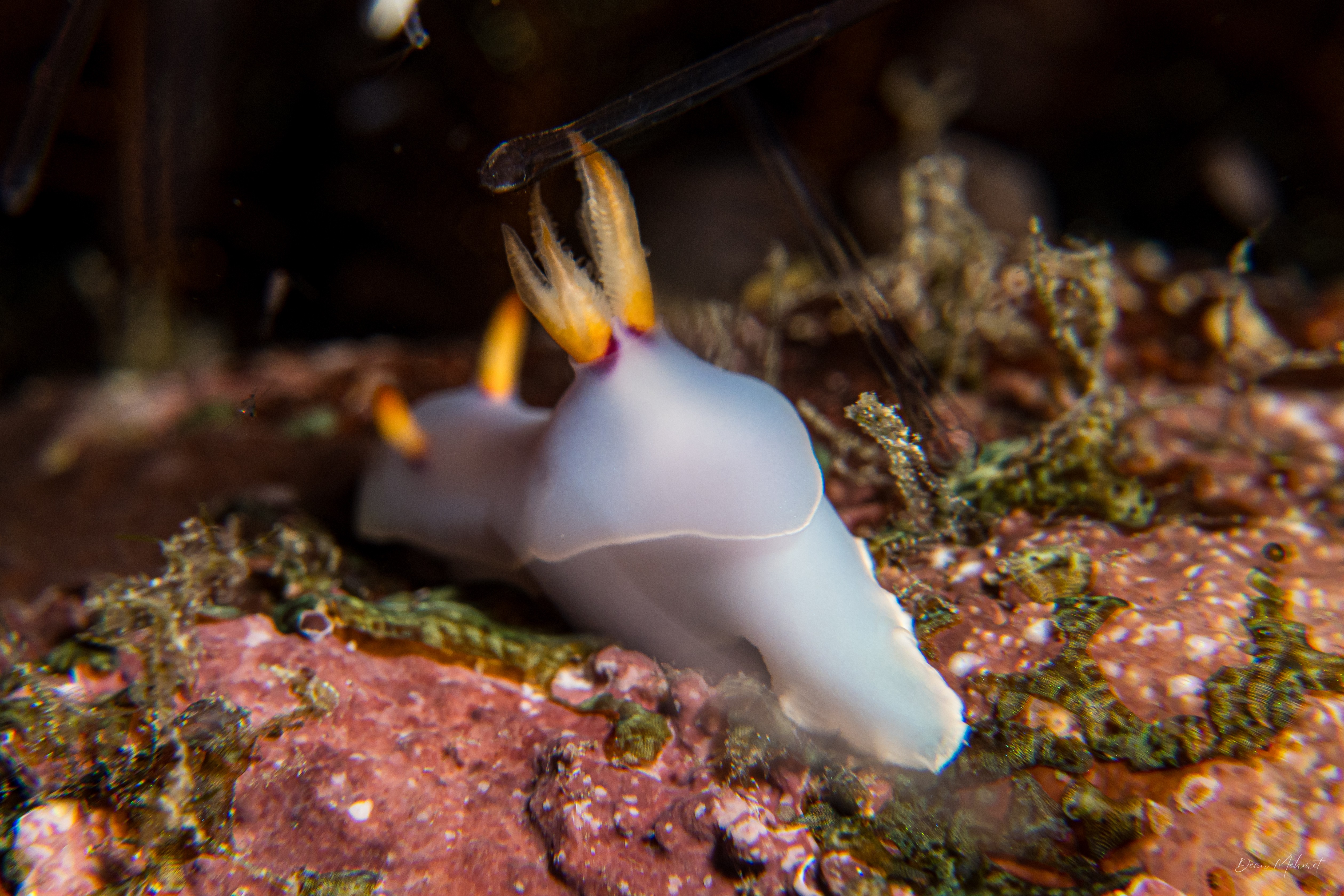
Conclusion: Hypselodoris melanesica
Reviewed by Codex identification research on Sep 5, 2026 · 94% reviewer confidence.
Reasoning recorded at review
- The body is translucent white to very pale lilac rather than strongly pink or deep purple
- A thin pale band follows the mantle and foot margin
- Both rhinophore sheaths have narrow, sharply defined deep-purple basal rings
- The gill pocket has a narrow sharply defined deep-purple basal ring
- The rhinophore clubs and gill branches are orange, with darker orange distally
- The visible external combination matches the Papua New Guinea H. melanesica diagnosis
Alternatives considered
- Hypselodoris bullockii
Why plausible: This close sister species shares the general pink-purple body and orange appendages and was the iNaturalist computer-vision label.
Comparison: H. bullockii usually lacks these narrow sharply bounded basal rings; anatomy or DNA would be needed for confirmation.
- Hypselodoris brycei
Why plausible: A pale body, violet marginal pigment and orange appendages can look similar in a single photograph.
Comparison: The expected broad deep-violet mantle margin is not visible here, and current evidence places H. brycei in Western Australia; specimen evidence would resolve any residual doubt.
Evidence limits & sources +−
- • A true-colour dorsal frame would better establish the pale-lilac body and thin white margin
- • Internal radular and reproductive characters are not available
- • DNA is required for confirmed separation from the very close H. bullockii lineage
Reading between the lines: Hypselodoris revision ↗Primary paper · Epstein et al. (2019), Zoological Journal of the Linnean Society 186: 116-189 · H. melanesica account, Fig. 18E and pp. 148-151; biogeography pp. 181-182 · checked Sep 5, 2026 · full frame suppliedContribution: The narrow well-defined purple rings at the rhinophore and gill bases, pale-purple body, orange appendages and Papua New Guinea occurrence support probable H. melanesica over H. bullockii.WoRMS current name check ↗Taxonomic register · MolluscaBase via WoRMS, AphiaID 1297847 · Hypselodoris melanesica taxon record · checked Sep 5, 2026Contribution: WoRMS lists Hypselodoris melanesica Gosliner & R. F. Johnson, 2018 as accepted; this validates the name, not the photograph.


