Skip to content
S

Search everywhere

Find your next encounter

Try a route into the archive

Search connects the whole archive

Common and scientific names, taxonomy, trips, locations, dive sites, buddies, and indexed photo subjects are all included.

Geometric Goniobranchus

Photographic identification review

Evidence for this exact frame

Reviewed hypotheses are preserved separately from the current archive label and from iNaturalist computer vision. They record what the photograph supports, what remains plausible, and what the frame cannot resolve.

1 assessment

Latest audit record

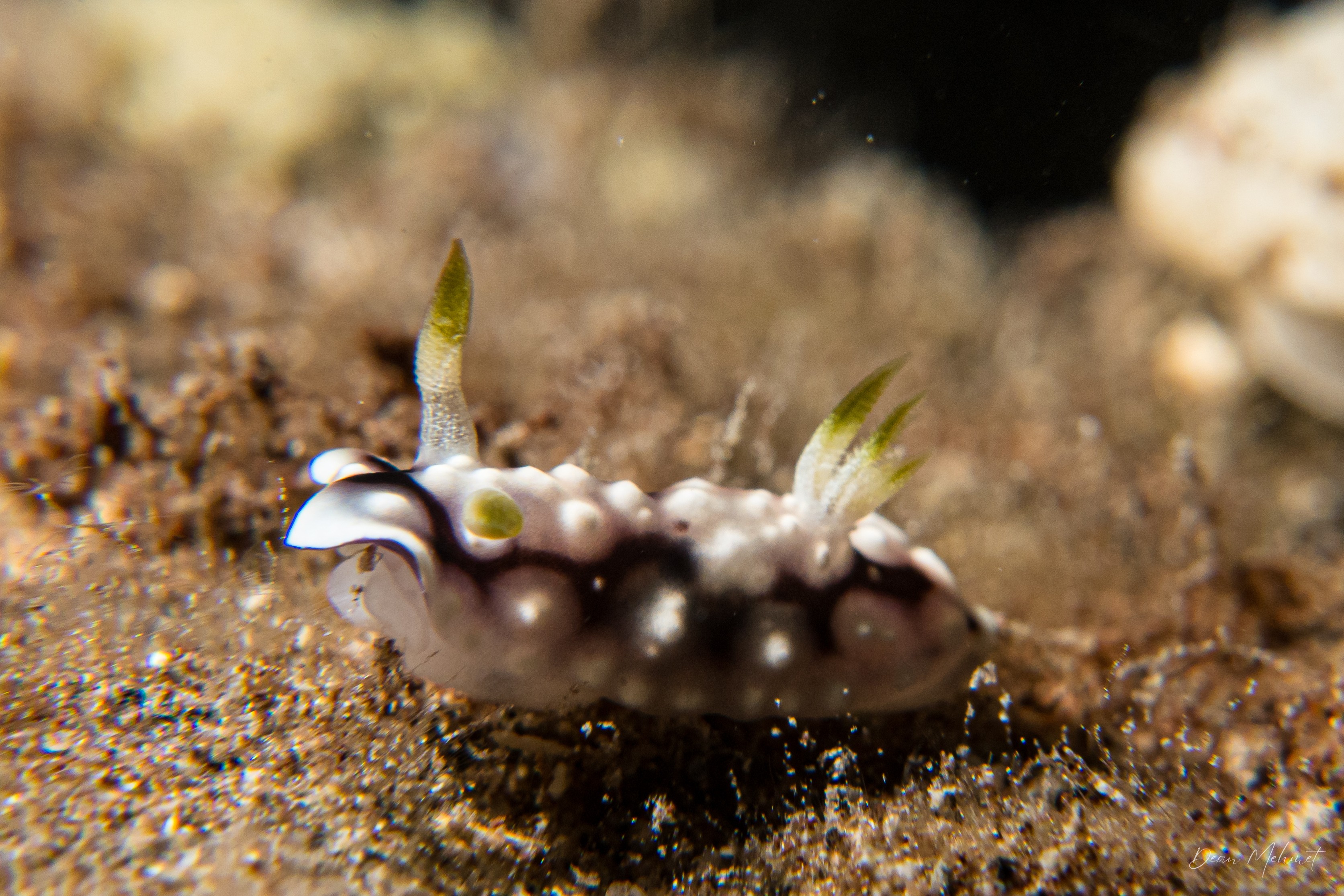
Conclusion: Goniobranchus geometricus

Reviewed by Codex identification research on Aug 29, 2026 · 96% reviewer confidence.

Reasoning recorded at review

  • The dorsum carries multiple rounded creamy-white to yellowish raised pustules rather than flat spots alone.
  • Dark brown to purple pigment forms connected reticulations between the pale pustules; the relative dark and pale coverage is variable.
  • The rhinophores and seven-to-eight-gill circlet are translucent and white-speckled basally with green to greenish-yellow distal pigment.
  • Where exposed, the lifted anterior mantle shows the supporting purple ventral crescent described for western-Pacific G. geometricus.
  • The clear side view resolves raised pale pustules, connected dark reticulation, white-speckled greenish appendages, and a purple anterior ventral crescent.

Alternatives considered

  • Goniobranchus conchyliatus

    Why plausible: The Indian Ocean counterpart shares a pale pustular body with darker pigment following the pustule contours.

    Comparison: G. conchyliatus should have red to reddish-orange rhinophores and gills; the visible appendages here are greenish-yellow, but specimen anatomy or molecular evidence would be required for formal confirmation.

  • Goniobranchus hintuanensis

    Why plausible: Another white-pustular western-Pacific chromodorid with a grey-brown network.

    Comparison: G. hintuanensis should show reddish-brown pigment on rhinophore lamellae/midlines and gill edges plus paired diffuse dark fields, rather than the greenish distal appendage pattern visible here.

  • Other white-pustular Goniobranchus / Glossodoris

    Why plausible: Yonow explicitly notes multiple pale pustular chromodorids that can be confused from incomplete photographs.

    Comparison: A conflicting appendage pattern, flat rather than raised pale markings, or absence of the inter-pustular network would require a broader specimen-backed comparison.

Evidence limits & sources +
  • • No voucher anatomy or molecular sequence is available, so the conclusion remains probable rather than confirmed.
  • • Underwater white balance may shift green-yellow appendage pigment; body structure and pattern organization must remain part of the decision.
  • • The complete ventral surface, radula, and reproductive anatomy are not available from these photographs.
Ambon chromodorid specimen treatment ↗Primary paper · Yonow, N. (2001). Results of the Rumphius Biohistorical Expedition to Ambon (1990). Part 11. Doridacea of the families Chromodorididae and Hexabranchidae. Zoologische Mededelingen 75: 1-50. · Chromodoris geometrica account, pp. 15-16 and pl. 2 fig. 4; C. hintuanensis account, pp. 16-18 · checked Aug 29, 2026 · comparison image suppliedContribution: The raised cream pustules, dark brown-purple inter-pustular network, greenish white-speckled appendages, and visible anterior crescent agree with the eastern-Indonesian G. geometricus material.Western Indian Ocean G. conchyliatus treatment ↗Primary paper · Yonow, N. (2012). Opisthobranchs from the western Indian Ocean, with descriptions of two new species and ten new records. ZooKeys 197: 1-130. · Chromodoris conchyliata account and plates 39-40 · checked Aug 29, 2026 · comparison image suppliedContribution: The comparison retains G. conchyliatus explicitly but its red/orange appendage pattern conflicts with the greenish appendages visible here.Modern chromodorid classification ↗Primary paper · Johnson, R. F. & Gosliner, T. M. (2012). Traditional taxonomic groupings mask evolutionary history: a molecular phylogeny and new classification of the chromodorid nudibranchs. PLOS ONE 7(4): e33479. · Goniobranchus classification · checked Aug 29, 2026Contribution: Supplies the current Goniobranchus combination for literature using Chromodoris geometrica; it is nomenclatural context rather than photographic evidence.WoRMS accepted name record ↗Taxonomic register · MolluscaBase eds. (2026), Chromodoris geometrica Risbec, 1928, accepted as Goniobranchus geometricus (Risbec, 1928). · AphiaID 559717 · checked Aug 29, 2026Contribution: Confirms the original and accepted-name relationship; it does not identify the photograph.

Connected record

What this frame carries

Date
Jul 17, 2026
Site
Tawali Resort House Reef
Dive
Dive 3 - Tawali Resort House Reef
Depth evidence
4.8m · profile-estimated
Water
24.0°C
Identification
99% confidence

Environmental values describe this archive encounter. Profile-estimated depth is aligned from capture time and the dive-computer profile; it is not camera-recorded depth.