
Latest audit record
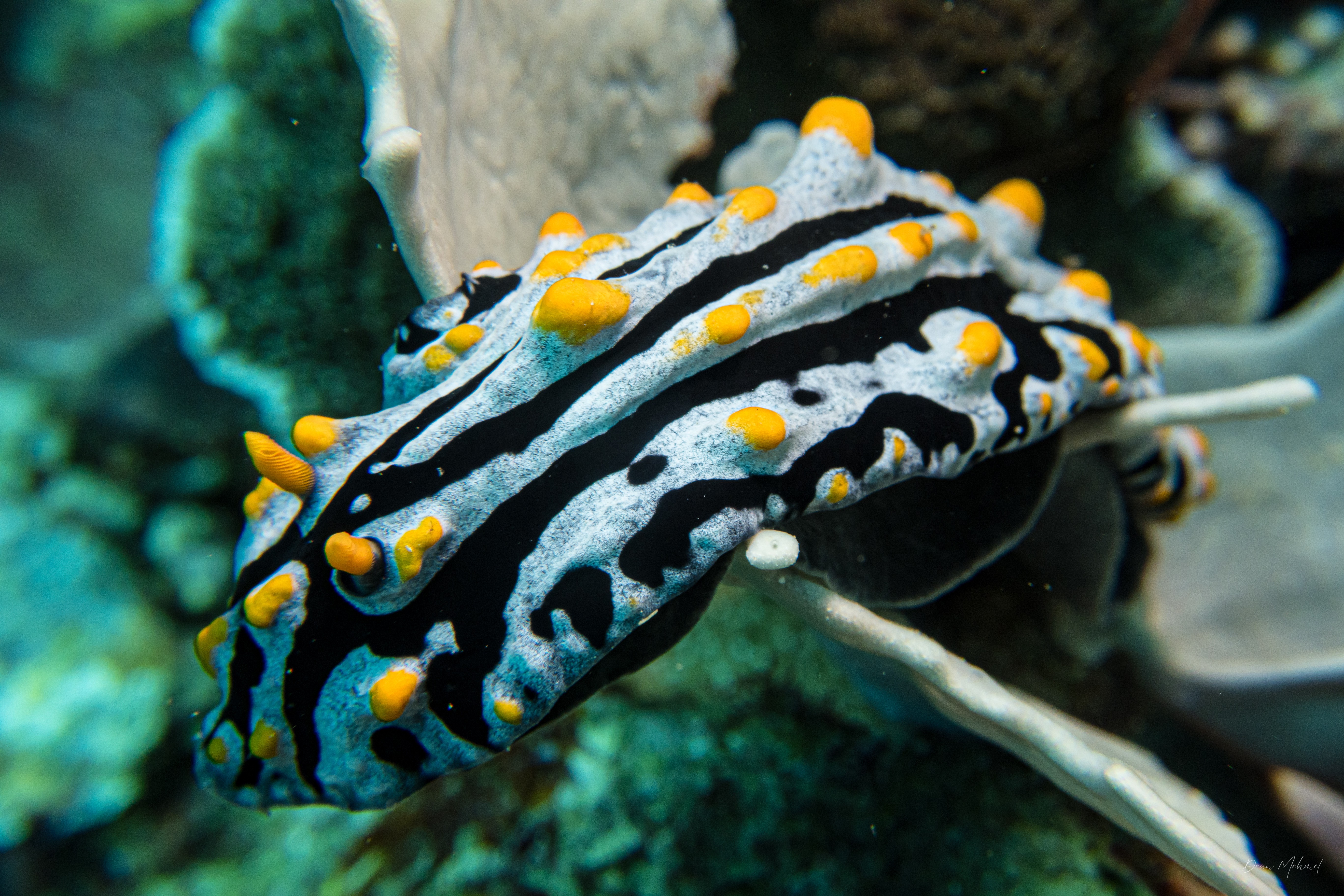
Conclusion: Phyllidia varicosa
Reviewed by Codex identification research on Aug 29, 2026 · 88% reviewer confidence.
Reasoning recorded at review
- Large adult-like animal with tall, continuous longitudinal blue-grey tuberculate ridges
- Several broad black longitudinal bands run between the ridges and branch toward the margin
- Prominent ridge tubercles have yellow-orange caps
- The visible lamellate rhinophore is yellow-orange
- The high ridges and elongate side profile closely match adult Phyllidia varicosa in Papu et al. (2022)
Alternatives considered
- Phyllidia haegeli
Why plausible: The modern revision warns that P. haegeli can be mistaken for P. varicosa from dorsal photographs and shares this colour-and-ridge combination.
Comparison: The frame contains dark dorsal markings but no opening can be identified confidently as the anus; a clear dorsal or ventral anal view is required.
- Phyllidia alyta
Why plausible: P. alyta shares black dorsal lines and orange tubercles.
Comparison: Its western Indian Ocean account describes a more linear four-line pattern and smaller, less-developed ridges; a ventral sole view and expert assessment would be needed to support it here.
Evidence limits & sources +−
- • Anal opening position is not unambiguously visible
- • The dark underside in the side view does not expose a diagnostic sole stripe or oral tentacles
- • No measured live body length
- • No rhinophoral lamella count, internal anatomy or DNA
Integrative taxonomy of Phyllidiidae ↗Primary paper · Papu et al. 2022 · Fig. 5.3a-e and P. haegeli account, PDF pp. 14-15; Fig. 6.2a-i and P. varicosa account, PDF pp. 16-17 · checked Aug 29, 2026 · full frame suppliedContribution: Adult form and dorsal ridges strongly support P. varicosa, while the explicitly documented P. haegeli lookalike keeps the assessment below confirmed.Systematics and phylogeny of phyllidiid nudibranchs ↗Primary paper · Brunckhorst 1993 · Phyllidia varicosa remarks, PDF p. 29 · checked Aug 29, 2026 · full frame suppliedContribution: The photograph shows the diagnostic ridge and cap combination, but not the black sole stripe or 27-30 rhinophoral lamellae.Western Indian Ocean opisthobranch accounts ↗Primary paper · Yonow 2012 · Phyllidia alyta account, Fig. 17 and Plate 61 · checked Aug 29, 2026 · full frame suppliedContribution: P. alyta is retained only as a weaker pattern alternative; the photographed adult's massive ridges and Tawali locality do not positively support it.


