
Latest audit record
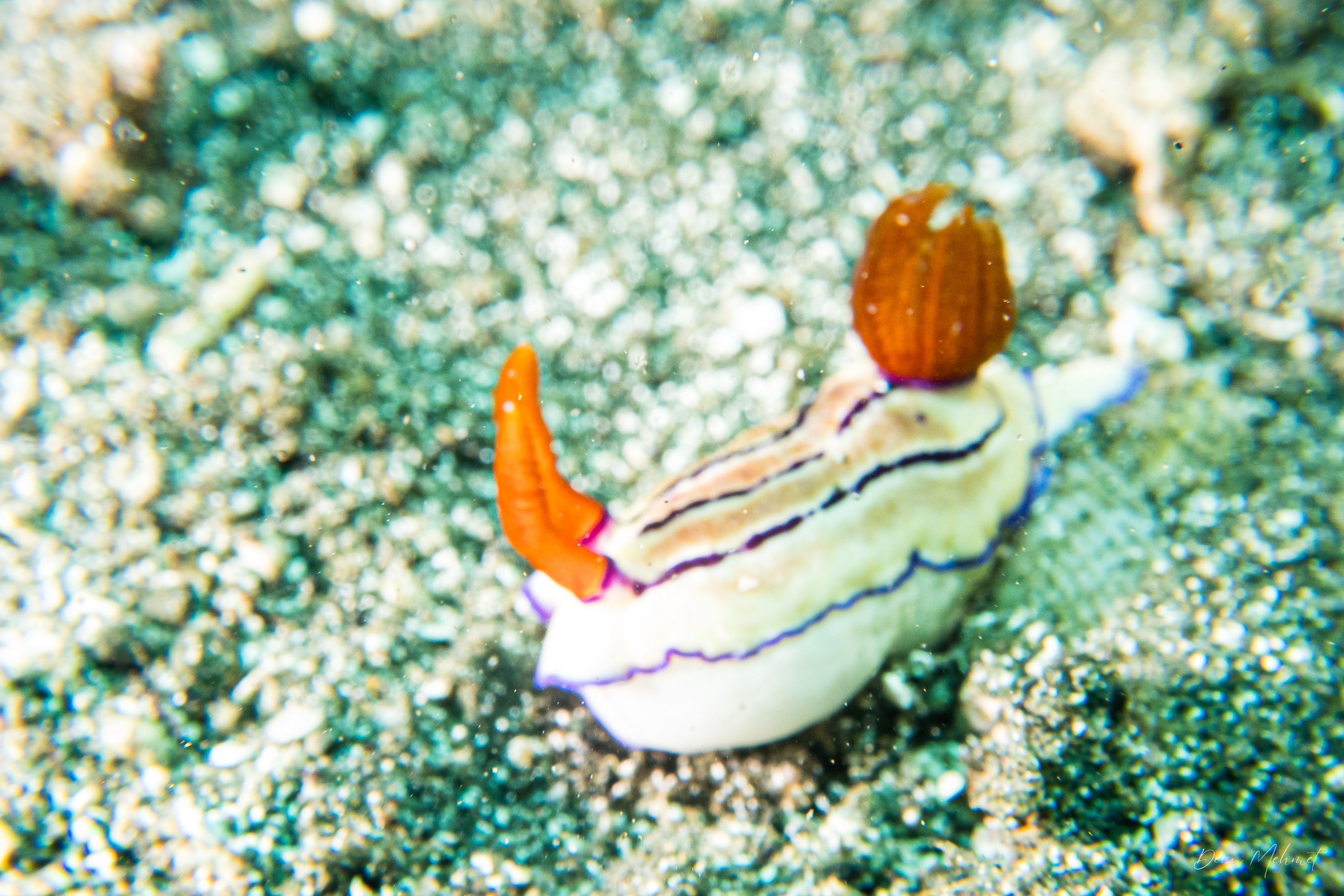
Conclusion: Hypselodoris emma
Reviewed by Codex identification research on Sep 5, 2026 · 95% reviewer confidence.
Reasoning recorded at review
- The mantle is cream to pale yellow with a narrow purple edge
- Three principal purple longitudinal lines are visible on the dorsum
- Diffuse tan-brown longitudinal fields lie between the purple lines
- The lateral purple lines curve around the rhinophores and converge behind the gill pocket
- The rhinophores and gill plume are orange-red with purple pigment at their bases
- The visible three-line pattern supports H. emma rather than the five-line whitei-maridadilus form
Alternatives considered
- Hypselodoris whitei
Why plausible: This close relative shares a pale body, purple longitudinal lines and orange-red appendages.
Comparison: H. whitei generally has five principal purple lines and white-tipped rhinophores and gills; neither combination is present clearly here.
- Hypselodoris maridadilus
Why plausible: This close relative can have uniformly orange appendages and the same general line colour.
Comparison: It normally has five principal purple lines and is primarily a western Indian Ocean lineage; anatomy or DNA would be required if external pattern conflicts arose.
Evidence limits & sources +−
- • A sharper true-colour dorsal frame would resolve any small white appendage-tip pigment
- • Internal anatomy and DNA are unavailable, so the photographic conclusion remains probable
Reading between the lines: Hypselodoris revision ↗Primary paper · Epstein et al. (2019), Zoological Journal of the Linnean Society 186: 116-189 · Hypselodoris phylogeny and colour-pattern discussion, pp. 116-189, especially H. maculosa subclade · checked Sep 5, 2026 · full frame suppliedContribution: The revision retains H. emma, H. whitei and H. maridadilus as distinct close relatives and emphasizes subtle consistent longitudinal and appendage-colour patterns.Original Hypselodoris emma description and comparison ↗Primary paper · Rudman (1977), Zoological Journal of the Linnean Society 61: 351-397 · H. emma account and H. lineata colour-group comparison · checked Sep 5, 2026 · full frame suppliedContribution: The three purple dorsal lines, intervening brown fields and orange-red appendages match the original external pattern of H. emma.WoRMS current name check ↗Taxonomic register · MolluscaBase via WoRMS, AphiaID 209596 · Hypselodoris emma taxon record · checked Sep 5, 2026Contribution: WoRMS lists Hypselodoris emma Rudman, 1977 as accepted; this validates the name, not the photographic identification.


